Yin And Yang

Balance
Friday, February 12, 2010
Tuesday, February 9, 2010
Focus your efforts on your one Big Idea for best results.
"There is a quote by Paul Valery. He met Einstein at a party in the 1920s, and he asked him
'Do you carry a notebook' around?
Einstein asked, 'Why?',
and Valeria said 'To write down your ideas, to put them down,'
and Einstein said, 'I only have one idea.'
Conclusion:
To succeed, you only have to have one idea—two ideas, you’re dead.
Or at least this is how Nassim Taleb interprets this conversation.
He says he has only one big idea: UNCERTAINTY.
Uncertainty regarding markets has two parts:
i) math and computation
ii) psychology
'Do you carry a notebook' around?
Einstein asked, 'Why?',
and Valeria said 'To write down your ideas, to put them down,'
and Einstein said, 'I only have one idea.'
Conclusion:
To succeed, you only have to have one idea—two ideas, you’re dead.
Or at least this is how Nassim Taleb interprets this conversation.
He says he has only one big idea: UNCERTAINTY.
Uncertainty regarding markets has two parts:
i) math and computation
ii) psychology

Monday, February 8, 2010
It is a big world out there.
A Pakistani Muslim Sufi devotee smokes a cannabis cigarette in a Christian grave yard next to the Data Darbar the burial place of the Saint Syed Ali bin Osman Al-Hajvery shrine, popularly known as Data Ganj Bakhsh, during the three-day annual ''Urs'' religious festival in Lahore on February 3, 2010.
In popular Sufism (i.e., devotional practices that have achieved currency in world cultures through Sufi influence), one common practice is to visit the tombs of saints, great scholars, and righteous people.
Data Ganj Bakhsh was a Persian Sufi and scholar during the 11th century. He was born in Ghazni, Afghanistan (990 AD) during the Ghaznavid Empire and settled and died in Lahore spreading Islam in South Asia. During the festival the shrine is lit up with candles and lights, donated dinner is prepared for the people and Sufies dance around and musicians play music for hours.
He significantly contributed to the spreading of Islam in South Asia. Born around 990 CE in Ghazni, Afghanistan during reign of the Ghaznavid Empire and died in Lahore (in present day Punjab, Pakistan) in 1077 CE. His most famous work is The Kashf Al Mahjub ("Unveiling the Veiled") written in Persian language. The work debates Sufi doctrines of the past.
Hujwiri belonged to the Junaidia school of Sufism. These sufis followed Junaid Baghdadi of Baghdad. Hajwiri is also viewed as an important intercessor for many Sufis.
Hujwiri belonged to the Junaidia school of Sufism. These sufis followed Junaid Baghdadi of Baghdad. Hajwiri is also viewed as an important intercessor for many Sufis.
Classical Sufi scholars have defined Sufism as "a science whose objective is the reparation of the heart and turning it away from all else but God." Alternatively, in the words of the renowned Darqawi Sufi teacher Ahmad ibn Ajiba, "a science through which one can know how to travel into the presence of the Divine, purify one’s inner self from filth, and beautify it with a variety of praiseworthy traits.
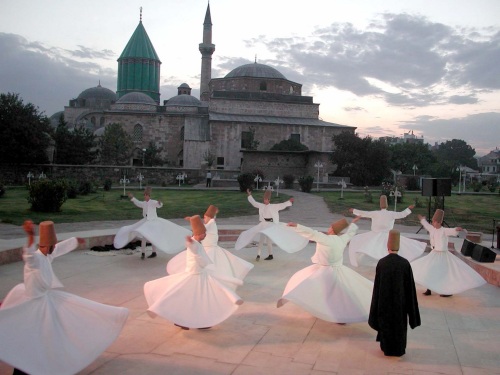
Whirling Dervish at Rumi's Tomb

Sunday, January 24, 2010
Subscribe to:
Posts (Atom)